Designing Japan Travel Trips That Fit You
There’s a quiet thrill that comes with imagining Japan travel trips before anything is pinned down—before the bookings, before the logistics, before the questions start piling up. You might picture yourself walking beneath autumn maples in Kyoto, sitting at a counter in a Tokyo alleyway, or listening to snow fall outside a mountain onsen. Those images are what draw so many people to Japan. But turning that vision into a trip that feels effortless rather than exhausting takes more than enthusiasm and a well-saved Instagram folder. At Japan Travel by Ryo, I shape every Japan travel trip around one central question: what does your best travel experience actually look like—not on a screen, but in real, lived days?
I was born in Tokyo, and after more than 15 years in the travel industry—living in Sydney and Lisbon, exploring over 50 countries—I’ve learned that a memorable Japan travel trip is never about fitting the most in. It’s about designing a journey that moves at your speed, reflects your curiosities, and holds enough flexibility to breathe. In this article, I want to explore what goes into crafting Japan travel trips that feel personal, not packaged, and why the planning process matters at least as much as the places themselves.
The quiet complexity behind every Japan travel trip
Japan is a country that can feel both wonderfully orderly and surprisingly opaque to international travellers. The trains are famously punctual, yet the ticketing systems layer reserved, non-reserved, limited express, and regional operators in ways that confuse even seasoned travellers. Restaurants that serve some of the most unforgettable meals often don’t appear on English booking platforms, taking reservations exclusively by phone—in Japanese. Accommodation quality varies enormously, and what looks like a peaceful ryokan in a curated blog post may turn out to be a cramped room far from any useful transport.
Seasonal demand magnifies all of this. During cherry blossom season, the finest rooms in Kyoto and Tokyo disappear within days of being released. Autumn foliage creates similar pressure, and ski destinations like Hakuba and Niseko see Australian visitors booking months ahead. For many travellers, the gap between what feels possible in theory and what actually works on the ground becomes clear only after they’ve arrived—often when changes or disruptions hit and there’s no easy way to communicate with a ticket office or hotel front desk in Japanese. A well-designed Japan travel trip accounts for all of these layers long before a suitcase is packed.
How I approach each Japan travel trip as a living design
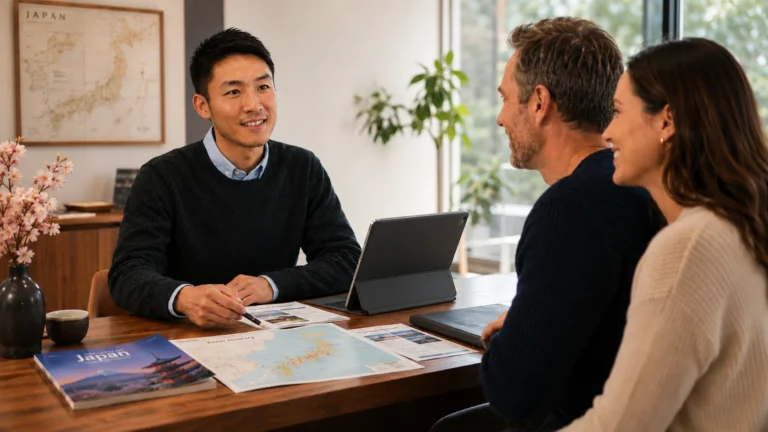
No two Japan travel trips I create at Japan Travel by Ryo ever look the same, because no two travellers bring the same rhythm, interests, or priorities. I start not with a preset route but with a deep discovery conversation. I want to understand what matters: whether you love slow mornings or are energised by packed days, if food is the main event or a supporting character, whether you’ve been to Japan before or are stepping into it fresh.
From there, I build the trip piece by piece. I book rail journeys directly inside Japanese systems, so I can change reservations on the spot if a client decides to linger somewhere or something unexpected disrupts the schedule. I select accommodation based on firsthand knowledge—room size, station proximity, genuine atmosphere—and for luxury properties I can often layer in Virtuoso benefits like room upgrades, daily breakfast, and late check-out that aren’t accessible through public platforms. I call restaurants in Japanese to secure tables at places that simply can’t be booked any other way. I coordinate luggage forwarding so travel days feel light rather than burdensome. And throughout the trip itself, I’m available by message for any question, big or small, backed by a dedicated after-hours support team with full access to every booking.
- Custom-designed itinerary built from scratch around your pace and travel style
- Direct booking within Japanese rail and accommodation systems, enabling real-time flexibility
- Restaurant reservations handled in Japanese, opening doors to venues beyond English platforms
- Luggage forwarding seamlessly arranged so multi-city travel stays comfortable
- Personal, ongoing support from me during the trip, plus 24/7 after-hours backup
Trips that follow the seasons
Japan’s seasonal rhythms are so distinct that I often say the country offers four different destinations depending on when you visit. Late March into April brings cherry blossoms and a collective national pause for hanami picnics under pink canopies. November sets hillsides on fire with autumn colour, especially around Kyoto’s temples. December through March transforms the Japanese Alps into some of the best ski terrain in Asia, while summer hums with festivals, fireworks, and the scent of street stall yakitori.
A Japan travel trip designed with seasonality as the spine feels completely different to one that treats it as an afterthought. For cherry blossom season, I often recommend starting early in Kyushu or Tokyo and moving northward as the bloom front shifts—avoiding the heaviest crowds while staying in sync with nature. For autumn, I might anchor a trip around Kyoto and the surrounding mountains, building in early morning temple visits before the tour buses arrive. For ski trips, I map logistics carefully: coordinating Shinkansen and local bus connections to resorts, ensuring accommodation is genuinely ski-in/ski-out rather than just marketed that way, and often recommending a city-based recovery day at the end to ease back before the flight home.
The key is starting early. Most Japanese hotels open bookings roughly six months before the stay date, and during peak windows the best-located rooms vanish almost immediately. I typically begin working with clients six to seven months ahead for popular seasons, giving us the widest field of genuinely suitable options rather than whatever is left.
Trips that reach beyond the cities
Tokyo, Kyoto, and Osaka sit at the top of almost every first-timer’s list for good reason. But some of the most memorable Japan travel trips I design deliberately veer away from those well-trodden paths. The country is dotted with pottery villages, historic post towns, rural onsen hamlets, and small family-run workshops where traditions have been alive for generations.
I’m currently developing a signature experience centred on Japan’s Six Ancient Kilns—pottery villages like Bizen, Tamba, and Shigaraki—where visitors can step into working kilns and meet the artisans directly. These places are not convenient to reach and almost entirely absent from English-language booking platforms. They require local connections, Japanese-language outreach, and a willingness to navigate rural transport networks. That’s exactly the kind of access a Japan travel trip designed with local knowledge can unlock. For travellers who want more than the standard highlight loop, these quieter corners of Japan often become the part of the trip they talk about longest.
Trips built around food and culture
Food is rarely just fuel in Japan; it’s a window into place, season, and craft. A Japan travel trip designed around eating well might include a tiny sushi counter in a Tokyo backstreet where the itamae only speaks Japanese, a riverside kaiseki meal in a Kyoto machiya, or a steaming bowl of ramen at a shop that’s been perfecting its broth for three generations. But these experiences hinge on reservations, and in Japan, the best places rarely appear on large online booking platforms.
I handle every restaurant reservation directly, making phone calls in Japanese and navigating each venue’s specific booking system. I also match dining to the natural rhythm of the trip. A multi-course kaiseki dinner on arrival night after a long flight and Shinkansen transfer? I’d gently suggest a simpler meal and move that special dinner to a day when you’re rested and ready to savour it. Similarly, I build in market mornings, depachika food hall explorations, and opportunities to try regional specialities that shift with each prefecture you pass through. A Japan travel trip that’s underpinned by thoughtful food choices simply tastes better.
Trips where transport becomes invisible
The best Japan travel trips share a common trait: you don’t spend mental energy on how to get from one place to another. Transport logistics have been resolved so thoroughly that they fade into the background. That’s what I aim for in every itinerary I design.
I map out exactly which trains to board, which platforms to stand on, and which exits to take at complex stations like Shinjuku, Shibuya, and Osaka/Umeda. I specify when a Japan Rail Pass makes financial sense and when individual tickets offer better flexibility. Because I book inside Japanese rail systems rather than through third-party resellers, I can reissue tickets in minutes if something changes—a delayed temple visit, a spontaneous decision to stay longer, or an honest mistake like disembarking one station too soon. And I always coordinate luggage forwarding, known as TA-Q-BIN, so that on travel days you’re carrying only a small overnight bag while your suitcase waits at your next hotel. For multi-city Japan travel trips, this single service can transform the entire experience.
What makes these trips feel different
A Japan travel trip that’s been designed with local knowledge and direct support bears little resemblance to one patched together from online sources. The difference shows up in quiet moments: a hotel upgrade that was waiting for you because of Virtuoso access, a reservation at a restaurant you never would have found alone, the lack of panic when a train is cancelled because someone who speaks Japanese is already sorting it out.
- Personalised pacing that respects your energy and lets each place settle, rather than rushing you between sights
- On-the-ground flexibility supported by direct booking access and real-time Japanese communication
- Hidden experiences—pottery kilns, family-run eateries, rural ryokans—that exist beyond the reach of English platforms
- Verified accommodation quality, so what you expect is what you actually walk into
- The reassurance of travelling with an IATA and ATAS accredited specialist who’s personally invested in your trip
At Japan Travel by Ryo, Japan travel trips are personal by design
At Japan Travel by Ryo, I don’t build Japan travel trips by pulling items from a standard menu. I listen first, then shape something around the people travelling—their pace, their fascinations, their threshold for movement and change. I was born in Tokyo, and I bring a lifetime of local understanding to every decision, from which neighbourhood makes a good home base to which train car offers the quietest ride. My career in travel has spanned everything from large corporate agencies to boutique advisory work, and I’ve come to believe that the right approach is always personal, never volume-driven.
That’s why I intentionally limit how many clients I take on at any time. A deeply customised Japan travel trip demands sustained attention, not assembly-line processing. When you travel with me, you’re in direct contact with the same person who designed your itinerary—before, during, and after your journey. Behind the scenes, my business is IATA and ATAS accredited through the 1000 Mile Travel Group, meaning you’re protected by industry-standard financial safeguards and supported by a 24/7 after-hours team that can step in when I’m offline. It’s the combination I believe matters most: the intimacy of a boutique specialist with the infrastructure of an established agency.
Starting your own Japan travel trip
If you’re beginning to imagine Japan travel trips of your own, a few simple starting points can save months of confusion and help you land on something that feels genuinely yours.
- Get clear on what moves you most—quiet countryside, vibrant city energy, deep food exploration, hands-on craft—before deciding where to go
- Think about your ideal daily pace; a lighter itinerary with fewer stops almost always yields richer memories than a crammed schedule
- Start the conversation early, especially for peak seasons, so you have access to the best accommodation and experiences before they fill
- Factor luggage forwarding into your thinking from the start; travelling light on the Shinkansen changes everything
- Identify the few meals or cultural moments that would make your trip feel complete, and build outward from there
Let’s talk about the Japan travel trip you have in mind
Every Japan travel trip begins with a conversation. At Japan Travel by Ryo, I offer a free, no-obligation discovery call where we can talk through the kind of experience you’re looking for, the rhythm that suits you, and how I can help shape a journey that feels effortlessly yours. I’ll then prepare a sample itinerary outline so you can see the level of detail I bring to every trip I design, without any commitment to go further. You can reach me through the enquiry form at jpntravelbyryo.com, or email me directly at info@jpntravelbyryo.com. From a slow-paced cultural immersion to a ski-and-onsen escape, I’d be glad to help you craft Japan travel trips that stay with you long after you return home.